

Not sure if eco-friendly pest control can handle Florida's bugs? Here's an honest look at what works, what doesn't, and why it matters where you live.
Share:
Summary:
If you’ve been searching for eco-friendly pest control in St. Lucie County, you’ve probably run into two camps: companies that swear chemicals are the only real solution, and companies that claim their green products handle everything. Neither answer is entirely honest.
The truth is more useful than that. Eco-friendly pest control has come a long way, and for most homes in Port St. Lucie and the surrounding Treasure Coast, it’s not just a safer option — it’s often the smarter long-term one. But there are real trade-offs worth understanding before you make a decision.
Here’s what we’ve seen after nearly two decades of treating homes and businesses across this area.
The biggest misconception about green pest control is that it’s a compromise — that you’re trading effectiveness for safety. That’s not what the research shows. A study published in the journal Crop Protection found that Integrated Pest Management programs reduced pesticide use by 50 to 70 percent while maintaining or improving pest control effectiveness.
What makes eco-friendly approaches work isn’t just the products — it’s the framework behind them. Instead of defaulting to a spray schedule, the focus is on inspection first, identifying why pests are getting in, and targeting the root cause rather than just what’s visible. That distinction matters a lot in St. Lucie County, where pests don’t take a winter break.
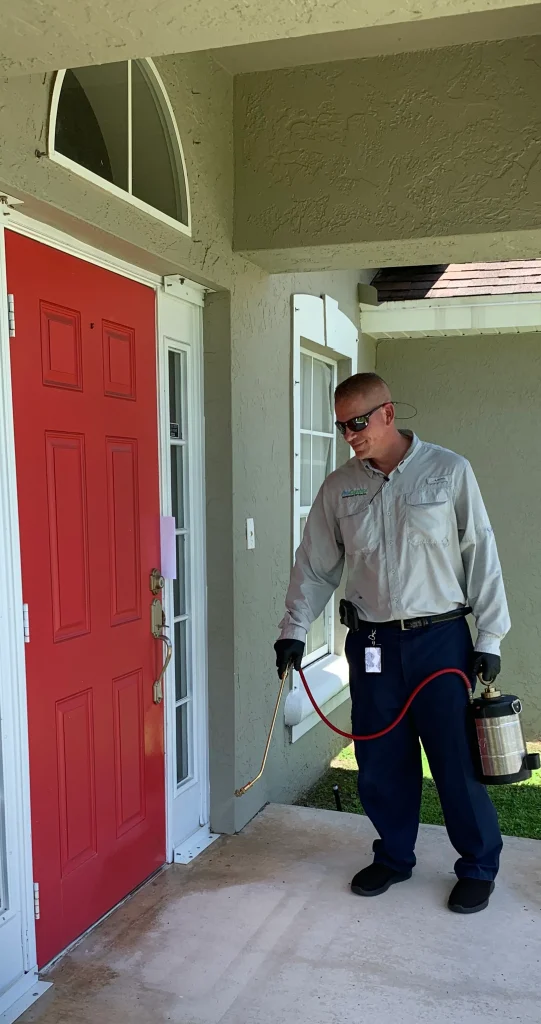
These terms get used interchangeably, but they’re not the same thing — and the difference is worth knowing. Organic pest control refers specifically to products derived from natural sources: plant-based compounds, minerals, biological agents. Eco-friendly pest control is a broader category that includes organic options but also encompasses low-toxicity synthetic products, exclusion methods, habitat modification, and the overall strategy of minimizing chemical use wherever possible.
Here’s what often surprises people: organic doesn’t automatically mean safer. Some naturally occurring substances are quite potent, and some synthetic products approved for eco-friendly use have very low toxicity profiles. The more useful question isn’t “is this organic?” — it’s “how targeted is this treatment, how toxic is this specific product, and is it being applied in a way that protects my family and the surrounding environment?”
In St. Lucie County, that environment piece carries real weight. The Indian River Lagoon runs along the Treasure Coast, and it’s one of the most biodiverse estuaries in the country. Chemical runoff from broad-spectrum pesticide applications is a documented concern for local water quality. Many of our clients along the canals and waterfront neighborhoods in Port St. Lucie are aware of this — and it’s part of why they ask about eco-friendly options in the first place.
The practical takeaway: when you’re evaluating a pest control company’s “green” claims, ask us to be specific. What products are we using? What’s the application method? Are we doing a thorough inspection before any treatment, or just rotating products on a fixed schedule? A genuinely eco-conscious approach should be able to answer all of those questions clearly.
This is the question we hear most often — and it’s a fair one, especially in Florida. St. Lucie County isn’t dealing with one termite species. Eastern subterranean termites, Formosan termites, and Asian subterranean termites are all active here, sometimes in the same neighborhood. Eastern subterranean colonies alone can range from 60,000 to over 2 million members, and they work year-round because our climate never gives them a reason to slow down.
So can eco-friendly methods handle that? Yes — but only when the treatment is matched to the specific species, the severity of the infestation, and the construction type of the home. That’s exactly where inspection-first methodology earns its value. A blanket chemical treatment applied without identifying which species you’re dealing with, where they’re entering, and what moisture or wood conditions are attracting them is less effective than a targeted eco-friendly approach that addresses all of those factors.
We’ve been called in after other companies treated a home — sometimes more than once — and the termites came back. In most of those cases, the problem wasn’t that the product was too weak. The problem was that the root cause was never addressed. Moisture in a crawl space, wood-to-soil contact at the foundation, a gap around a pipe penetration — these are the conditions that invite termites back regardless of what chemical was applied.
That said, honesty matters here: there are situations where chemical intervention is the right call. A severe active infestation with significant structural involvement may require a more aggressive approach before transitioning to an eco-friendly maintenance plan. We’ll always tell you which situation you’re in, and we’ll never oversell an eco-friendly solution when a different approach is genuinely warranted.
For most of the homeowners who call us, the driving concern isn’t abstract — it’s their kids playing on the floor, their dog walking through a treated yard, or their elderly parent who spends a lot of time at home. Those are legitimate concerns, and they deserve a direct answer rather than vague reassurances.
Traditional synthetic pesticides — particularly organophosphates and pyrethroids — can leave residues that persist on surfaces for weeks. Children and pets face higher exposure risk simply because of how they interact with their environment: close to the ground, touching surfaces, sometimes putting things in their mouths. The EPA estimates that traditional pesticides contribute to millions of poisoning cases worldwide each year.
Eco-friendly treatments, applied correctly, are designed to minimize that residue risk while still getting the job done. The difference in a well-run IPM program isn’t just the product — it’s the precision.

This is one of the most common questions we get, and the honest answer is: it depends on what you’re treating. For active infestations, targeted eco-friendly treatments can work just as quickly as conventional methods. For prevention-oriented programs — which are the backbone of a good IPM plan — the results are gradual by design, because the goal is to eliminate the conditions that attract pests in the first place, not just kill what’s visible today.
In a place like Port St. Lucie, where the humidity stays high year-round and pests don’t have a dormant season, that prevention focus is actually more valuable than it would be in a northern climate. A chemical treatment that kills everything in sight in October still leaves a home vulnerable in November, December, and January — because the conditions that attracted those pests haven’t changed. An eco-friendly maintenance program that addresses moisture, entry points, and harborage areas creates compounding protection over time.
One thing worth understanding: pests are less likely to develop resistance to eco-friendly treatments than to synthetic chemicals used repeatedly. With conventional pesticides, repeated application can trigger genetic resistance in pest populations — meaning the same product becomes less effective with each treatment cycle. IPM-based approaches avoid this problem by varying methods and targeting root causes, which means your protection tends to hold up better over time, not worse.
For families in newer communities like Tradition or St. Lucie West, where new construction has displaced termite colonies and fire ant populations, that long-term durability is especially relevant. You’re not just treating a current problem — you’re building a defense against what’s going to keep coming.
The short answer is: not necessarily, and often not over time. The perception that green pest control is a premium product comes partly from the wellness industry, where “natural” and “organic” labels typically do command higher prices. Pest control works differently.
Some eco-friendly products do carry a slightly higher per-application cost than their conventional counterparts. But the more important number is how often you need to treat. A program that addresses root causes — sealing entry points, reducing moisture, eliminating harborage areas — tends to produce fewer repeat infestations than a chemical program that kills on contact but leaves the underlying conditions unchanged. Fewer callbacks, fewer emergency treatments, and fewer full retreatments add up to real savings over a year or two.
We offer free estimates for every client — residential, commercial, and industrial — so you can get an accurate picture of what a program would actually cost for your specific property before committing to anything. That’s true whether you’re in a waterfront home near the St. Lucie River, a newer build in Palm City, or a commercial property in Fort Pierce. The estimate is the starting point, not a sales pitch.
What we’d encourage you to ask us is not just “what’s the monthly cost?” but “what does this program actually prevent, and what happens if the pests come back?” Those answers tell you a lot more about the real value of what you’re buying.
Eco-friendly pest control isn’t the right answer for every situation — but for most homes in St. Lucie County dealing with Florida’s year-round pest pressure, it’s a more durable, more targeted, and genuinely safer approach than defaulting to broad chemical treatments on a fixed schedule.
The key is working with a company that actually practices what it claims. That means inspection before treatment, transparent product choices, and a plan that addresses why pests are getting in — not just what to spray when they do.
If you’ve already tried another company and the problem came back, that’s usually a sign the root cause was never addressed. It’s worth getting a second opinion before spending more money on the same approach.
We’ve been serving St. Lucie County and the Treasure Coast since 2006. We’re locally owned, fully licensed, and we back every service with a satisfaction guarantee. If you want to know what’s actually going on with your pest situation — and what would genuinely fix it — reach out for a free estimate.
Article details:
Share:
Continue learning: