Not all termites are the same — and in St. Lucie County, that distinction matters more than most homeowners realize. Here's what's actually living in your walls.
Share:
Summary:
If you’ve found what looks like a termite — or worse, a swarm of them — the first question most people ask is “how do I get rid of them?” But the more important question is: which kind do you have? St. Lucie County is home to multiple termite species, and they don’t all behave the same way, live in the same places, or respond to the same treatments. Getting that wrong is exactly why so many treatments fail. This guide walks you through the three most destructive termite types we encounter here, what sets them apart, and what you need to know before you call anyone.
When most people picture termites, they’re picturing subterranean termites — and in St. Lucie County, that instinct is right. Eastern subterranean termites are found in every corner of the county, from Fort Pierce to Tradition to Port St. Lucie. They live underground, build colonies that can reach into the hundreds of thousands, and travel through mud tubes to reach the wood in your home.
Then there’s the Formosan subterranean termite — a different animal entirely. Formosans are well-established throughout the Treasure Coast, and their colonies can hold anywhere from two to ten million workers. A mature Formosan colony can consume roughly a pound of wood per day. That’s not a slow, quiet problem. That’s structural damage happening in real time.
The most recognizable sign of subterranean termites is the mud tube — a pencil-width tunnel made of soil, wood particles, and termite saliva that runs along your foundation, walls, or any surface connecting the ground to a wood source. These tubes protect the colony from open air and predators. If you find one and it crumbles to reveal live termites inside, you have an active infestation. If it’s dry and hollow, the colony may have moved on — or just relocated nearby.
Swarmers are another sign people notice first, often because they’re alarming. In St. Lucie County, subterranean termite swarms typically happen between February and May, usually on warm evenings after rain. Formosan swarms, in particular, are hard to miss — large numbers of winged termites appearing suddenly around lights, windows, or doorframes. If you’ve seen this in Port St. Lucie or along the St. Lucie River corridor in spring, you already know how unsettling it looks.
One thing worth knowing: the presence of swarmers doesn’t mean the infestation just started. Swarmers are reproductive termites leaving an established colony to start new ones. By the time you see them, the original colony has likely been active for several years. That’s not meant to alarm you unnecessarily — it’s just the reality of how these insects operate, and it’s why waiting to see if the problem goes away on its own isn’t a strategy that works.
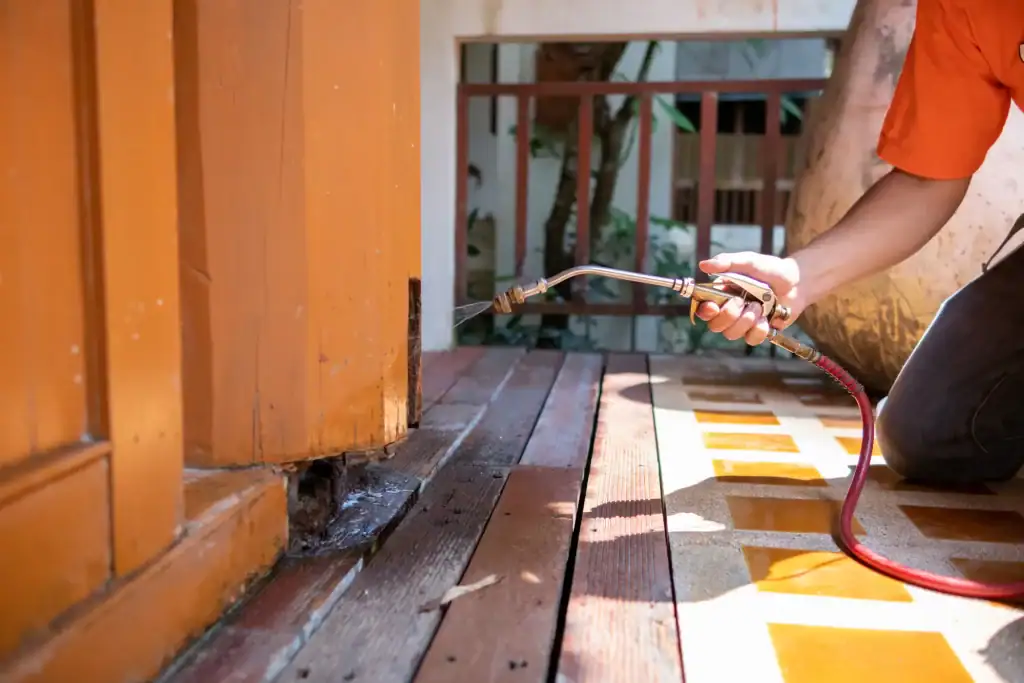
Subterranean termites require soil treatment or a monitored bait system to eliminate. Products like Termidor (a liquid barrier applied to the soil around the structure) and Sentricon (a bait system that workers carry back to the colony) are the two most established approaches we use. The right choice depends on your property’s layout, the severity of the infestation, and whether you’re dealing with a native Eastern subterranean colony or the far more aggressive Formosan species. That distinction genuinely changes the treatment plan.
Formosan termites get their own conversation because they deserve it. They’re not simply a “worse version” of Eastern subterranean termites — they behave differently, build differently, and require a more aggressive response. Where a native subterranean colony might number in the hundreds of thousands, a mature Formosan colony can reach into the millions. They also build secondary nests called cartons — a mix of chewed wood, soil, and moisture — inside wall voids, which means they can sustain activity without ever returning to the soil. That makes them significantly harder to eliminate with a standard liquid barrier treatment alone.
In St. Lucie County, Formosan pressure is real and ongoing. The county’s subtropical climate — warm winters, high humidity, and 50-plus inches of annual rainfall — creates ideal conditions for Formosan colonies to thrive year-round. Unlike northern states where cold winters interrupt termite activity, our winters don’t slow them down in any meaningful way. A colony that’s active in October is still active in January.
The other thing that catches homeowners off guard is how long Formosan damage can go undetected. These termites work from the inside out. By the time you see blistering paint, hollow-sounding wood, or sagging floors, the structural damage is already done. Roof trusses, floor joists, wall framing — all of it is fair game. And because termite damage isn’t covered by standard homeowner’s insurance, the financial exposure is entirely on the homeowner.
If a previous treatment didn’t hold, and you’re dealing with subterranean termites in St. Lucie County, Formosan termites should be on the list of possibilities. Misidentifying them as a native subterranean species — and treating accordingly — is one of the most common reasons we get called after another company has already been out.
Drywood termites are fundamentally different from subterranean species in one critical way: they never touch the ground. They live, eat, and reproduce entirely within the wood they infest — which makes them much harder to detect and, in many cases, harder to treat. The most common drywood species in South Florida is the West Indian drywood termite (*Cryptotermes brevis*), considered one of the most widely distributed drywood termite species in the world. The southeastern drywood termite (*Incisitermes snyderi*) is also present throughout the region.
Drywood colonies are smaller than subterranean ones — typically a few thousand individuals — but don’t let that number mislead you. Multiple colonies can infest a single structure simultaneously, each operating independently in different areas of the home.
The most telling sign of drywood termites is frass — the small, pellet-shaped fecal matter they push out of tiny holes in the wood. It looks a bit like coarse sawdust or coffee grounds, often found in small piles on windowsills, floors, or furniture. If you’ve noticed something like that and assumed it was just dust or debris, it’s worth a closer look.
Drywood termites swarm later in the year than subterranean species. In South Florida, their swarm season runs roughly June through October, coinciding with the rainy season. They enter homes through exposed wood — attic vents, roof eaves, window frames, door frames — and can also spread through infested furniture. That last point matters if you’ve recently moved or received secondhand furniture, because drywood termites travel with it.
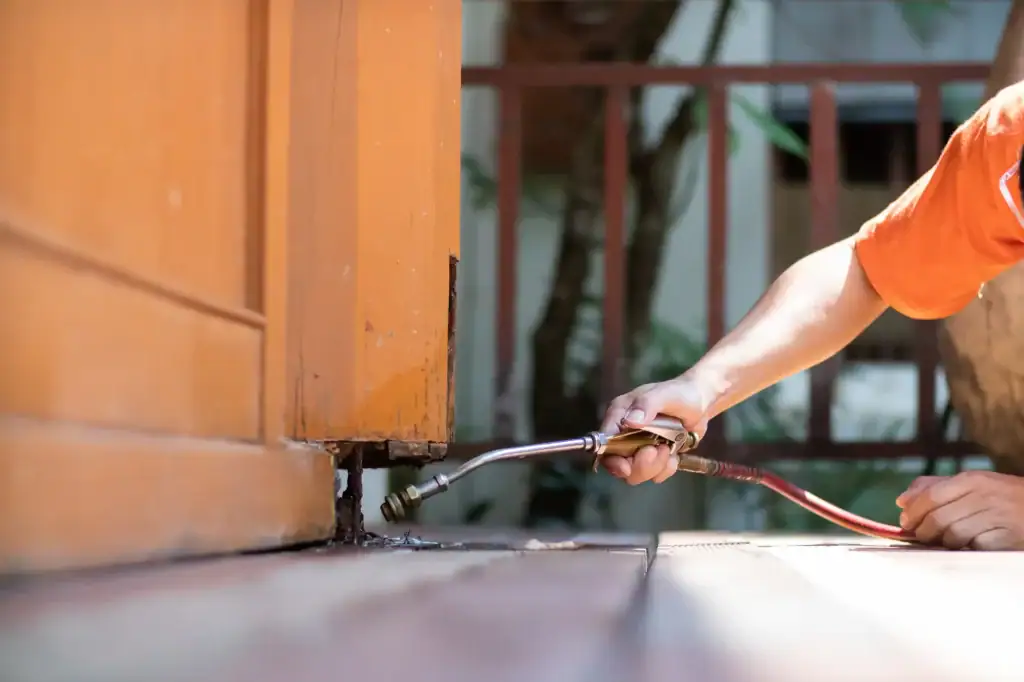
Because they don’t need soil contact, standard soil treatments do nothing to address a drywood infestation. The treatment options are either localized spot treatment (effective when the infestation is caught early and confined to a specific area) or structural fumigation — commonly called “tenting” — which is the only method that reaches every hidden gallery throughout the entire structure. Fumigation is more disruptive and requires preparation, but for a widespread drywood infestation, it’s the most thorough solution available.
The reason drywood infestations often go unnoticed for so long is that there are no mud tubes, no soil disruption, and no obvious external signs until the damage is significant. Fort Pierce homeowners in older wood-frame construction are especially vulnerable, simply because those structures have had more years of exposure and more opportunities for drywood termites to establish themselves quietly. If your home was built before 1980 and has never had a professional termite inspection, there’s a real chance something is already there.
Florida dampwood termites are the least talked-about species in the state — and that’s part of what makes them dangerous. Most homeowners have never heard of them, many pest control companies don’t think to look for them, and the treatment approach is different enough from other species that misidentification leads directly to failed results.
Two dampwood species are endemic to South Florida: *Neotermes castaneus* (the Florida dampwood termite) and *Prorhinotermes simplex* (the light dampwood termite). Unlike drywood and subterranean termites, dampwood termites require wood with elevated moisture content — typically above 15% — to survive. That requirement makes St. Lucie County a particularly hospitable environment for them.
Think about what defines this county geographically: the St. Lucie River running through Port St. Lucie, the Indian River Lagoon along the eastern edge, Taylor Creek, and the general flatland topography with a shallow water table. Annual rainfall consistently exceeds 50 inches, concentrated in a summer rainy season that keeps soil and structural wood moisture elevated for months at a time. On Hutchinson Island, you add salt air and coastal humidity to that equation. For dampwood termites, these conditions are ideal.
The damage pattern looks different too. Dampwood termites create smooth, clean galleries in the wood — almost polished-looking compared to the rougher tunneling of subterranean species. They don’t produce mud tubes and their frass is larger and more loosely packed than drywood frass. Because they’re associated with moisture-damaged wood, their presence is often a signal that there’s a water intrusion problem somewhere in the structure — a roof leak, plumbing issue, or drainage problem — that needs to be addressed alongside the termite treatment.
This is where treating dampwood termites without addressing the moisture source guarantees failure. Even if you eliminate the current colony, the conditions that attracted them remain. A thorough inspection looks at both the pest and the underlying problem driving it. For homeowners near the St. Lucie River, along the Intracoastal, or in communities where the rainy season brings standing water near foundations, dampwood termites deserve to be on the inspection checklist — even if no one has mentioned them before.
The most expensive termite mistake isn’t ignoring the problem — it’s treating the wrong species. Subterranean, drywood, and dampwood termites each require a different approach, and applying the wrong one doesn’t just waste money. It gives the actual infestation more time to grow while you think the problem is handled.
If you’ve seen swarmers, found frass, noticed mud tubes, or just have a gut feeling that something is off in your walls, the right first step is a professional inspection by someone who knows how to tell these species apart. That identification shapes everything that comes after — the treatment method, the timeline, the warranty, and the long-term outcome.
We’ve been doing this work in St. Lucie County since 2006, and a significant part of what we do is help homeowners who’ve already been through one failed treatment figure out what actually went wrong. If you’re in that situation — or you want to get ahead of it — reach out to us for a free estimate. We’ll tell you what you’re dealing with before we recommend anything.
Article details:
Share:
Continue learning: