Peak mosquito season in St. Lucie County hits hard and fast. Here's what's driving it — and what actually works to stop it.
Share:
Summary:
If you live in St. Lucie County, you already know the feeling. You step outside in June, maybe to enjoy your patio or let the kids play in the backyard, and within minutes you’re retreating inside. It’s not just annoying — it’s the kind of thing that makes you question why you bother having outdoor space at all.
The good news is that mosquito pressure in Port St. Lucie and the surrounding Treasure Coast isn’t something you just have to accept. But solving it takes more than citronella candles and a can of spray from the hardware store. Here’s what’s actually driving the problem — and what works.
Florida’s mosquito season doesn’t have a clean start and end date the way it does in northern states. In St. Lucie County, meaningful mosquito activity typically kicks off as early as February or March and doesn’t fully settle down until November. The real peak — the stretch where most homeowners go from mildly annoyed to genuinely fed up — runs June through October, aligning almost exactly with Florida’s rainy season.
That timing is not a coincidence. Every afternoon thunderstorm that rolls through Port St. Lucie creates new standing water across thousands of yards, swales, and retention ponds. Mosquitoes don’t need much — a single bottle cap of water left sitting for a week is enough to support a breeding cycle. When rain comes daily, the problem compounds fast.
What makes St. Lucie County particularly intense is the combination of heat, humidity, and landscape design. Temperatures here rarely dip below the 70°F threshold mosquitoes need to thrive, which means the breeding cycle never really shuts off. Add in the county’s subtropical climate and you have conditions that sustain mosquito populations in every single month of the year.
This is one of the most common things we hear from homeowners in St. Lucie County: “Every time it rains, they come back ten times worse.” That’s not your imagination — it’s biology, and it’s directly tied to how this area was built.
Much of Port St. Lucie was developed with lawn swales running along the front of residential lots and storm water retention ponds woven throughout neighborhoods. These features are designed to manage drainage, and they do that job well. But they also create persistent standing water that doesn’t drain quickly enough to prevent mosquito breeding. After a heavy rain, those swales fill up and sit. Within a week, the next generation of mosquitoes is already hatching.
Beyond swales and ponds, there are breeding sites hiding in plain sight in most yards. Bromeliads — the ornamental plants you see in landscaping all over St. Lucie County — hold water inside their leaf cups by design. That pooled water is a perfect nursery for Aedes aegypti, the species responsible for dengue, Zika, and chikungunya. Most homeowners never think to check them.
Clogged gutters, water pooling under decks, flower pot saucers, tarps, and even tree holes all contribute to the problem. The challenge is that you can do everything “right” — empty obvious containers, dump standing water — and still have a significant mosquito problem because the real sources are harder to see or impossible to fully eliminate on your own.
There’s also the flight factor. Adult mosquitoes don’t stay in your yard. They fly in from neighboring properties, nearby wetlands, and roadside drainage areas. Even if your yard is spotless, mosquitoes from surrounding areas will find their way in. That’s why source reduction alone — while genuinely helpful — rarely solves the problem completely in a densely developed area like Port St. Lucie.
The mosquito lifecycle runs approximately 21 days from egg to adult. In Florida’s summer heat, that cycle can compress. Populations rebuild quickly after a rain event, which is why a one-time spray never holds for long. Effective control has to account for both the adults already flying around and the eggs and larvae already developing in water — otherwise you’re just delaying the next wave by a week or two.
Not all mosquitoes are the same, and knowing which species you’re dealing with matters — both for understanding your risk and for choosing the right control approach.
The two most common types in Port St. Lucie and the surrounding Treasure Coast are Aedes aegypti and salt marsh mosquitoes. Aedes aegypti — sometimes called the yellow fever mosquito — is a small, dark species with white-banded legs that thrives in urban and suburban environments. Unlike most mosquitoes that bite at dusk and dawn, Aedes aegypti is active during the day. It prefers to feed on humans, tends to stay close to where it breeds, and is the primary carrier of dengue, Zika, chikungunya, and yellow fever. It’s the species most likely to be breeding in your yard.
Salt marsh mosquitoes are a different situation. They’re aggressive biters that emerge in large numbers, typically at dusk and dawn, and they’re associated with the coastal wetland areas that border parts of St. Lucie County. They don’t necessarily breed in your yard, but they will fly considerable distances to find a blood meal — meaning you can feel their impact even if your property is clean.
Beyond those two, St. Lucie County is home to mosquito species that carry West Nile virus and Eastern Equine Encephalitis (EEE). Our county government has issued active advisories for both in recent years, and 2024 saw record locally transmitted dengue cases across Florida, including in St. Lucie County and the surrounding region. These aren’t distant risks — they’re documented, local, and ongoing.
EEE, in particular, carries a mortality rate of 30 to 60 percent in humans. West Nile is more common but harder to track because many infections produce mild or no symptoms. Understanding that these diseases are circulating in your county — not just in some far-off tropical location — changes how you think about mosquito control. It’s not just about comfort. For families with young children or elderly relatives, it’s a genuine health consideration.
There’s a lot of information out there about natural mosquito control — essential oils, bat houses, mosquito-repelling plants, biological larvicides. Some of it is genuinely useful. Most of it works better as a supplement than a solution on its own, especially in a climate like St. Lucie County’s.
The real question isn’t “natural vs. chemical” — it’s “what actually works well enough to give you your yard back?” For many homeowners, that answer involves professional treatment. But what that treatment looks like, and whether it’s safe for your family and pets, matters a great deal.
We use eco-friendly formulations that are specifically chosen to be effective against mosquitoes while remaining safe for humans, animals, and the surrounding environment. That’s not a marketing line — it’s a practical standard we hold ourselves to because we serve families in this community, and we’re not interested in treating your yard with anything we wouldn’t be comfortable with ourselves.

“Eco-friendly” gets thrown around a lot in the pest control industry. It’s worth explaining what it actually means in practice, because there’s a real difference between a genuine approach and a label slapped on a brochure.
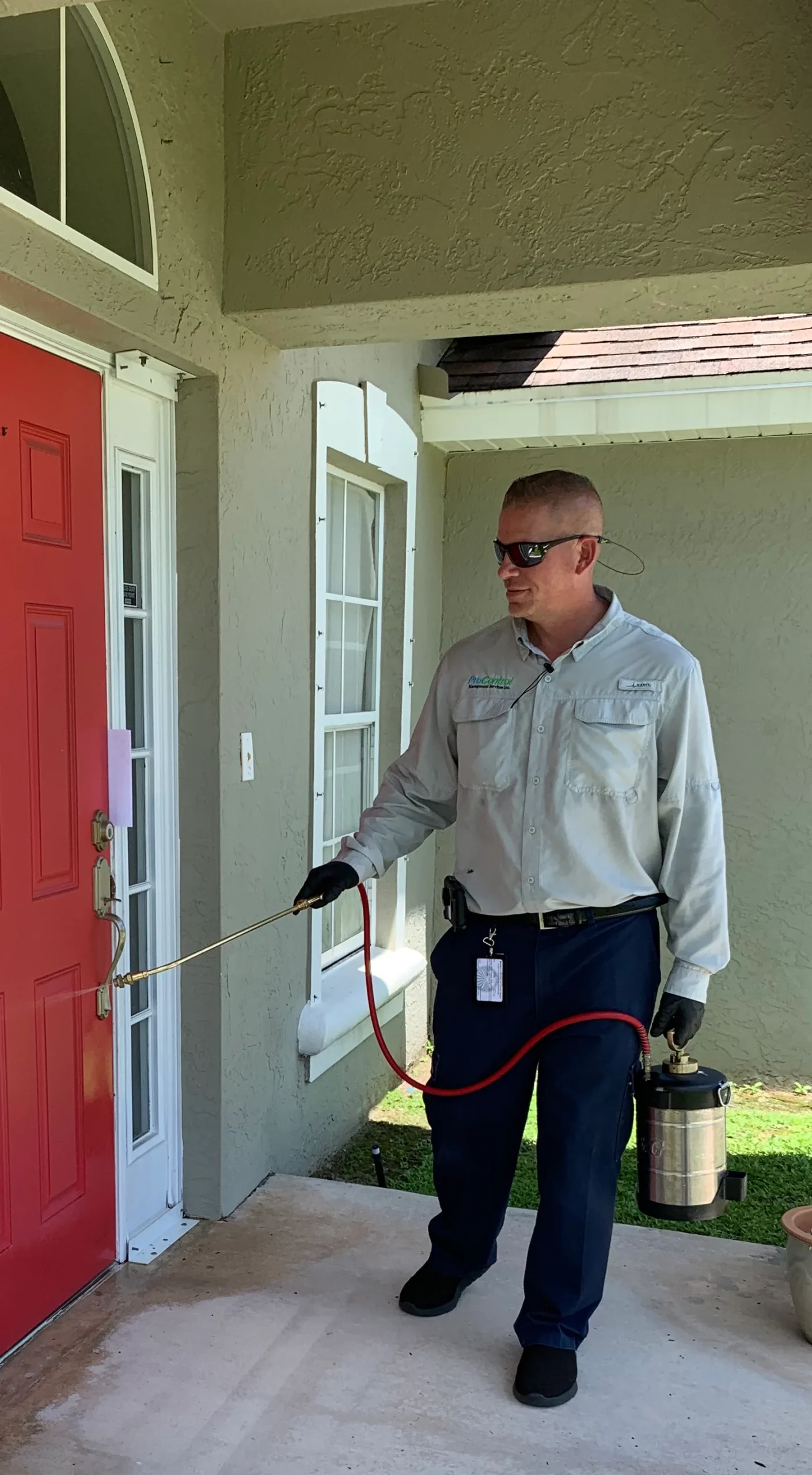
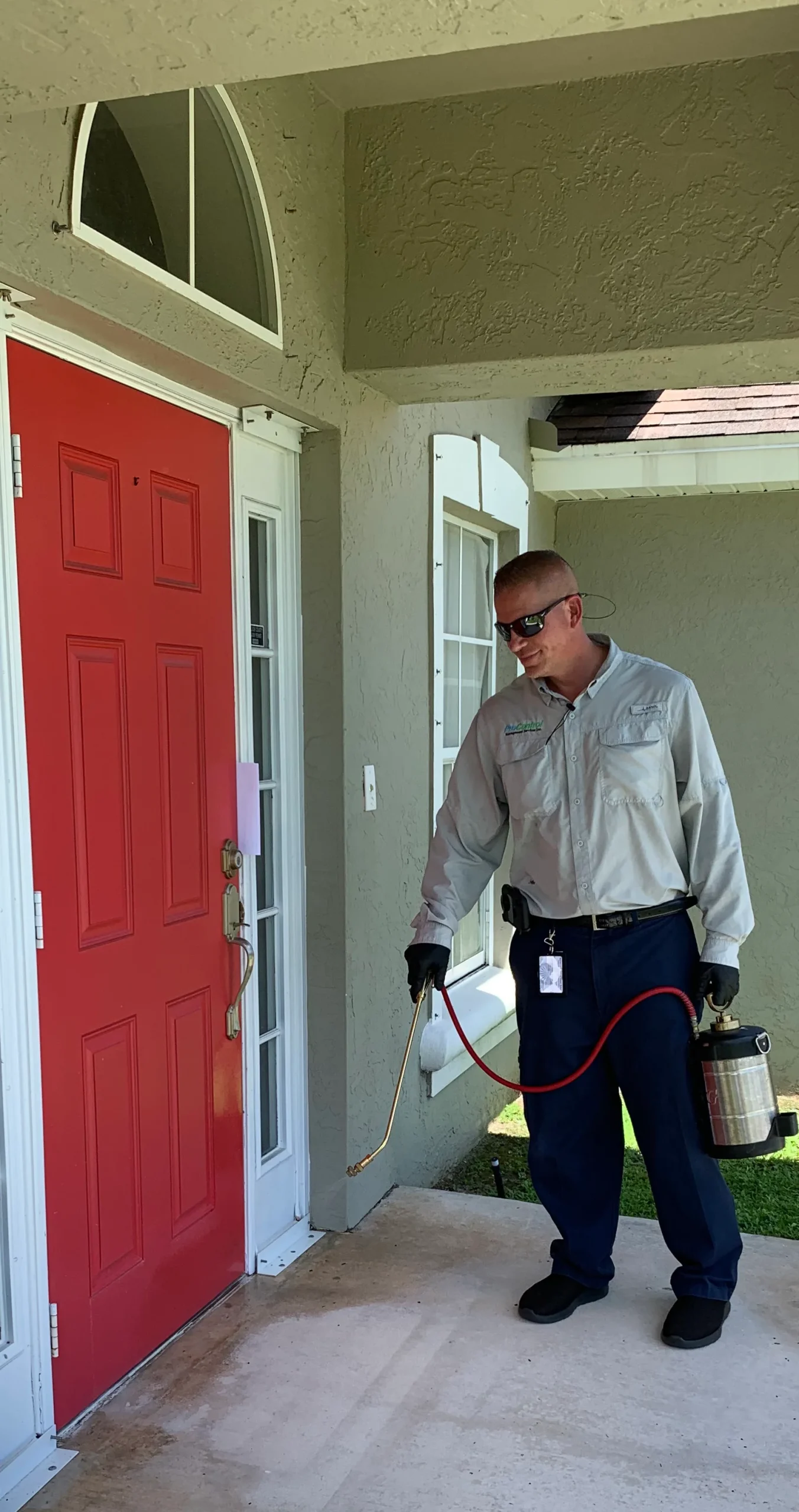
The second stage targets adult mosquitoes already active in your yard. A barrier spray is applied to the vegetation, shaded areas, and resting zones where mosquitoes spend most of their time during the day — under leaves, in dense shrubs, along fences and fence lines. Plant-derived formulations can be used here, and when applied correctly with calibrated professional equipment, they provide meaningful knockdown of the adult population.
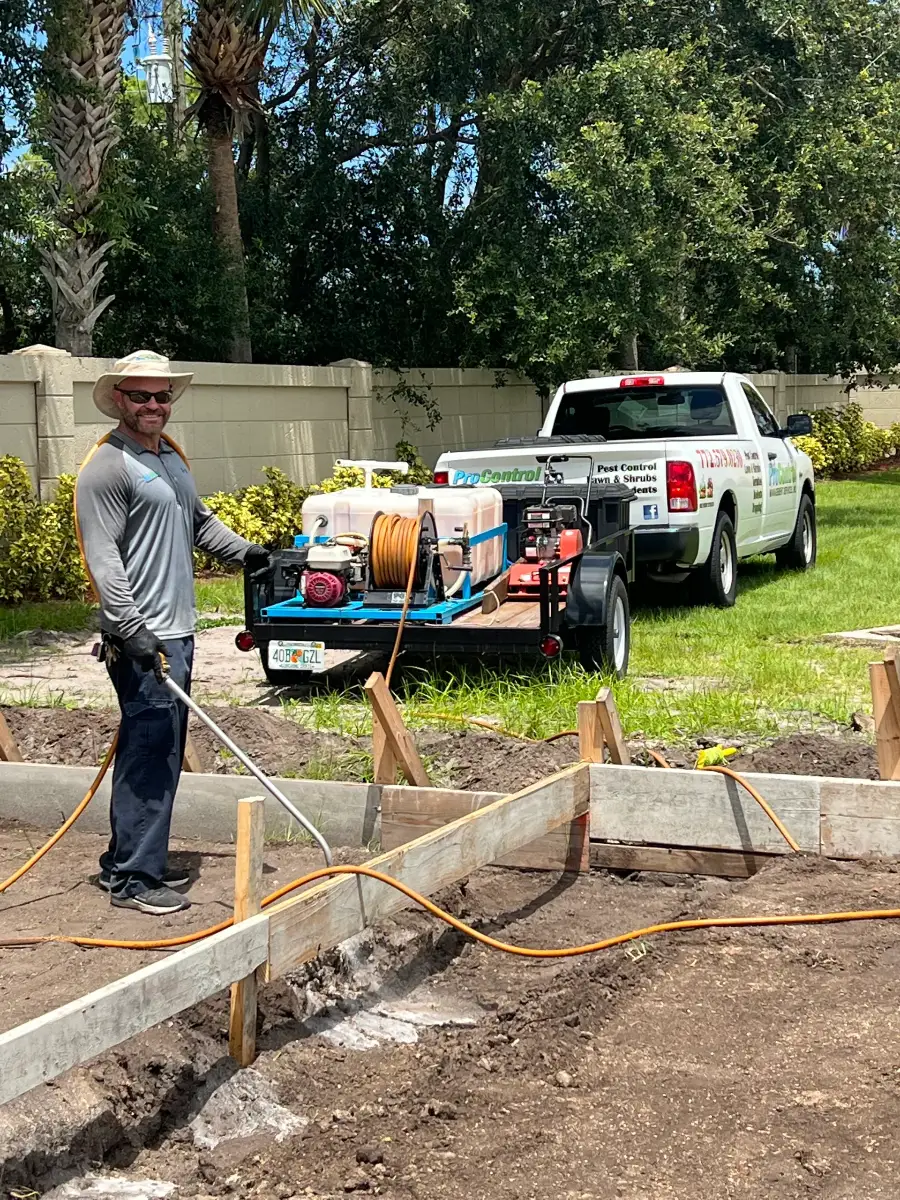
What makes our professional treatment more effective than store-bought products isn’t just the formulas — it’s the application. Consumer-grade sprays are diluted, applied without calibrated equipment, and almost never address the larval stage. You get a few days of relief, the next rain comes, and the cycle resets. Our professional treatment, done properly, disrupts the cycle at multiple points and is designed to hold for weeks, not days.
We also conduct a thorough property inspection before any treatment. That means walking your yard, identifying the specific breeding sites present on your property — whether that’s a bromeliad collection along the back fence, a swale that holds water for days after rain, or a clogged gutter you didn’t know was an issue — and building the treatment plan around what’s actually there. Every yard in Port St. Lucie is a little different. A good inspection changes what we do and where we focus.
One more thing worth saying: re-entry after treatment is safe. You don’t need to keep your kids and pets inside for days. We’ll give you clear guidance on timing, but our eco-friendly professional treatment is designed with household safety in mind from the start.
Most homeowners who call us have already tried to handle the problem themselves. They’ve removed standing water, bought the fogger from the home improvement store, tried the clip-on repellents, and maybe even called the county. And the mosquitoes are still there.
That’s the point where professional help stops being optional and starts being the practical next step. There’s no shame in it — Florida’s mosquito pressure is genuinely different from what most people experience elsewhere, and the DIY toolkit has real limits here.
A few specific situations where professional mosquito control makes the most sense: when you have consistent, heavy mosquito pressure despite removing obvious standing water; when you’ve had a recent rain event or tropical storm that flooded your yard; when you’re planning an outdoor event and need reliable protection for a specific date; or when you have young children, elderly family members, or immunocompromised individuals at home and the disease risk feels like something you can’t afford to gamble on.
It’s also worth understanding what the St. Lucie County Mosquito Control District does — and doesn’t — cover. The district manages mosquito control across 301 square miles of public land, roadsides, and areas of public health concern. That program is valuable, and we respect the work they do. But it does not treat private residential properties. Your yard is not part of their scope. If you’re relying on the county trucks driving through your neighborhood to protect your backyard, that gap is real.
We’ve been serving the Treasure Coast since 2006, and we’ve seen how quickly a manageable mosquito situation can spiral after a storm or during a particularly wet stretch of summer. The homeowners who call us after the fact often tell us they wish they’d set up a recurring treatment program before peak season hit. Proactive treatment — scheduled around the 21-day mosquito lifecycle — is almost always more effective and less disruptive than trying to catch up after an infestation has taken hold.
If you’re on the fence about whether the situation warrants a call, the answer is almost always yes. A free estimate costs you nothing, and knowing exactly what you’re dealing with is worth more than another week of guessing.
Mosquito season in Port St. Lucie and the surrounding Treasure Coast is long, intense, and driven by conditions that don’t respond well to half-measures. The heat, the rain, the swales, the bromeliads, the coastal wetlands — all of it stacks in the mosquito’s favor. What works is a combination of knowing where mosquitoes are actually breeding, treating at multiple stages of the lifecycle, and staying ahead of the problem rather than reacting to it.
The outdoor lifestyle is a big part of why people live here. Your backyard, your patio, your evenings outside — those things matter. Giving that up to mosquitoes every summer isn’t inevitable.
If you’re ready to stop guessing and start with a real plan, we at ProControl Management Services offer free estimates with no pressure and no obligation. We’ve been doing this in St. Lucie County since 2006, and we’ll give you a straight answer about what’s happening in your yard and what it will take to fix it. Reach out and let’s figure it out together.
Article details:
Share:
Continue learning: